Why are GNSS signals prone to jamming and spoofing?
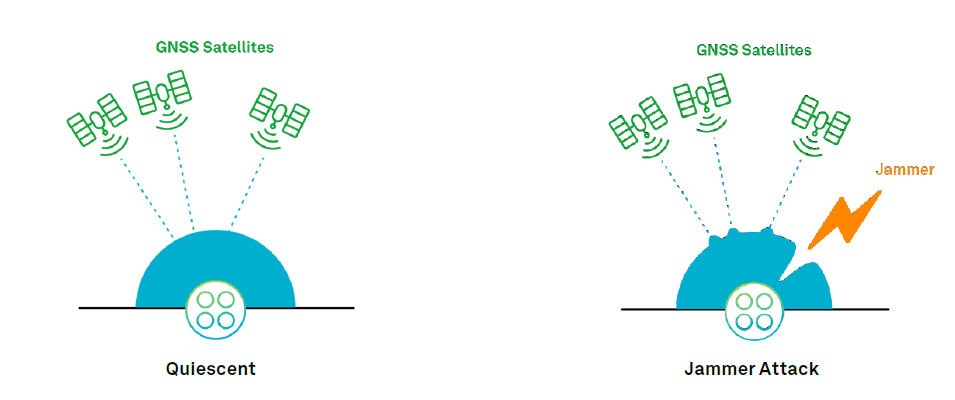
The RF spectrum is split into designated uses, so GNSS signal bands are fixed and of known frequencies, making them susceptible to jammers and spoofers emitting signals within the same frequency range. To make matters worse, by the time GNSS signals have travelled 20,000 – 25,000 km from the medium-Earth orbit (MEO) satellites to the receiver on the Earth’s surface, they are at a very low power level (-130 dBm or 10-13 mW) — 600 quadrillion (that’s 15 zeros) times weaker than a 60W lightbulb! This low power level makes the GNSS signals susceptible to interference from more powerful signals transmitted in the same frequency range. This is why powerful interference can overwhelm a GNSS receiver, and why protection and augmentation should be considered.
To download the full White Paper click here







 Contact us